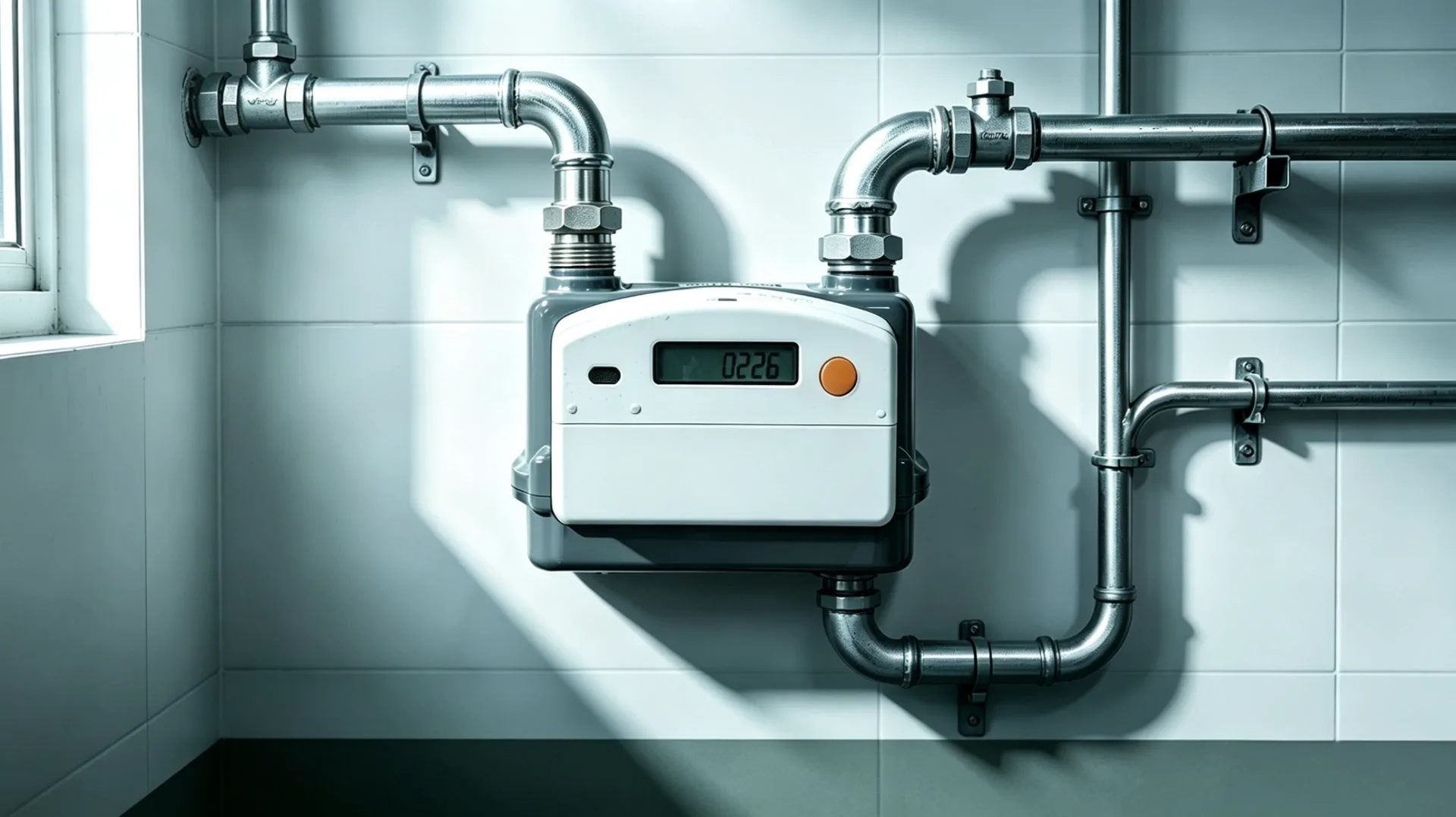

Between the gas you deliver and the gas you invoice there are three gaps. None of them is closed by paperwork — all three are closed where the gas is measured. And once closed, the data has to reach the billing system you already run.
Platform status: China Pattern Approval and explosion-proof certification are complete. Gas meters are quoted per project — this platform is not in series production.
None of these is a feature list. They are the three reasons a reconciliation does not balance at month end.
A cubic metre carries a different amount of energy at 0 °C than at 30 °C. Bill the raw volume and the same delivery is worth less in winter than in summer — every year, on every connection.
We convert to standard conditions while the gas is being measured, not months later in a spreadsheet. The invoice follows the gas instead of the weather, and no one has to explain a seasonal dip to the regulator. The converted figure goes straight into the existing billing system.
A worn mechanical meter starts late and stops early. Slow leaks and small burners can run for months without ever reaching an invoice — and nothing looks broken, because the meter still counts.
The meter samples faster whenever the flow changes, so the trickle appears as a night trend you can act on, not as a customer complaint you cannot explain. The trend is reported to the head-end you already run.
Diaphragms stiffen, gear trains wear, and a magnet can stop a mechanical meter in a minute. Accuracy decays quietly, and the loss lands in your reconciliation instead of in a work order.
Ageing becomes measurable instead of assumed. A meter that drifts is caught by its own trend, and interference or reverse flow is reported as an event with a timestamp — so the cost lands in a work order instead of in reconciliation.
No rotor, no chamber, no diaphragm — the reading starts at the first movement of gas and there is nothing to wear into an error.
Compensation and flow decisions are made as the gas passes, not corrected later in a billing system nobody can audit. What leaves the meter is a conclusion.
Accuracy you can put in front of an auditor or a regulator — a record per meter, not a batch certificate.
Send us the gap you can already see — a season, a zone, a consumer class — and how that data reaches your system today. We answer with the route to closing it and the shape of a first batch, not with a brochure.
Field trial first · approval route mapped per market · documents before payment.