

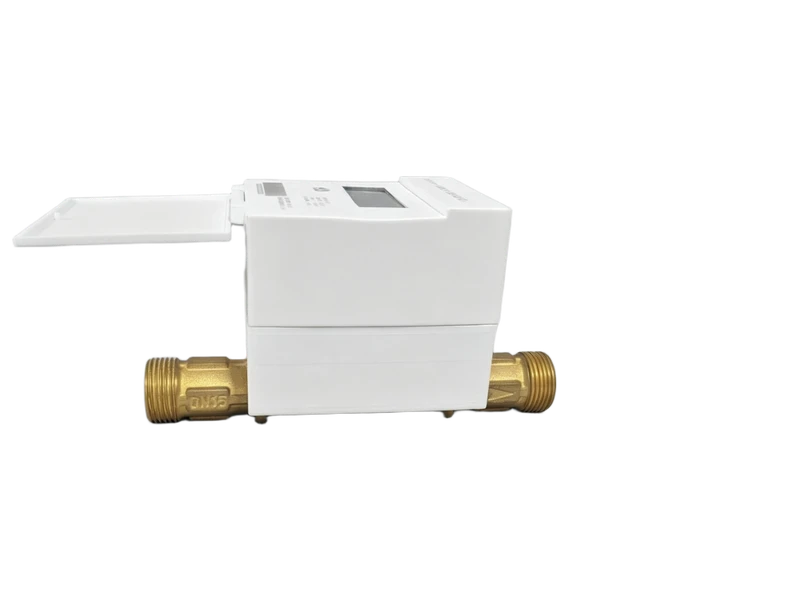
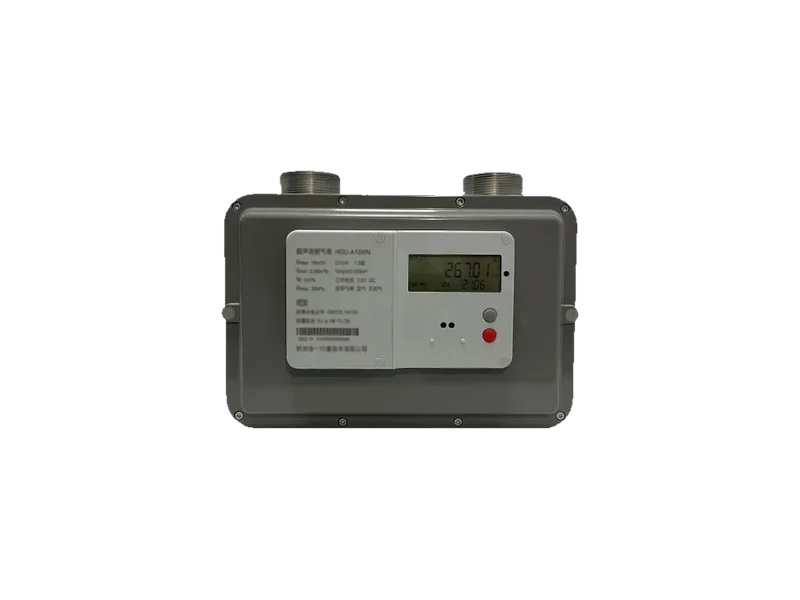
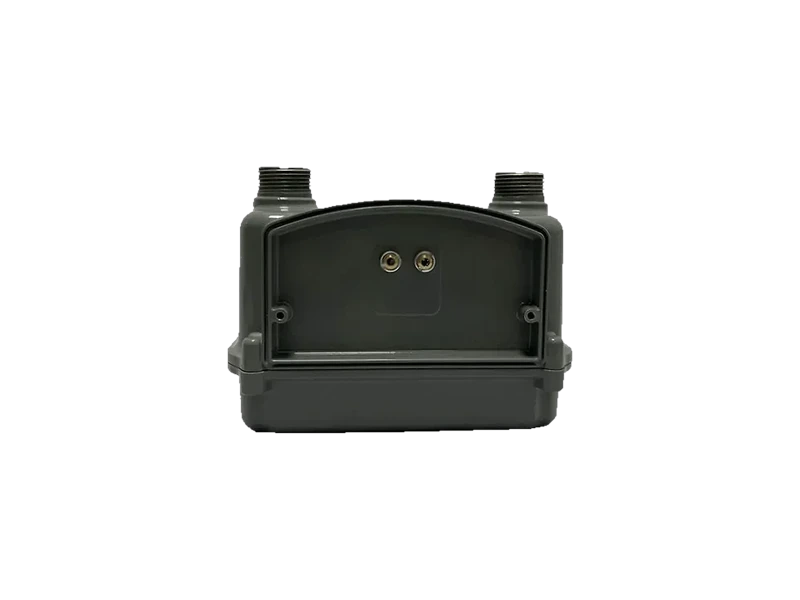
DN15–DN25 ultrasonic water meter in a lead-free brass body. Same R800 metering core as the polymer version, with standard thread connections for markets that prefer traditional materials.
Datasheet, dimension drawing and test report available on request.
Lead-free brass body with standard G¾″ / G1″ threads. Specified where the market expects brass rather than polymer.
Identical ultrasonic measuring element as the polymer meter — R800 range, starting flow from 1 L/h.
One-piece body with no openings in the measuring tube. No o-rings, no gaskets, no leak paths.
Submersible and installable in any orientation, with no straight pipe run required (U0/D0).
Figures from our own datasheets and type-test reports. Ask for the datasheet for the complete dimension drawings.
| Body material | Lead-free brass — suitable for potable water |
|---|---|
| Accuracy class | Class 2 — ISO 4064:2014 |
| Measurement range (Q3/Q1) | R500 / R800 |
| Thermal class | T30 / T50 |
| Operating temperature | -25 °C ~ 55 °C |
| Maximum working pressure | 1.6 MPa (MAP 16) |
| Pressure loss | Δp40 (≤ 40 kPa) |
| Protection class | IP68 — submersible |
| Flow sensitivity | U0/D0 — no straight pipe run required |
| Installation | Any orientation, horizontal or vertical |
| Bidirectional metering | Supported — reverse flow is measured and alarmed |
| Temperature compensation | Water temperature derived from the speed of sound; accurate across the full T30 / T50 range |
| Measuring frequency | 8 Hz, with online speed-of-sound verification |
| Event detection | Leaks (dripping) / pipe burst / reverse flow / empty pipe / low battery / strong magnetic attack |
| Environmental class | E2 / class O (outdoor installation) |
| Communication | Two configurations. Remote reading: local display plus an NB-IoT / LoRaWAN / CAT1 module, so the meter can be read on site or from the office. Local reading: the same meter and the same local display, supplied without a communication module — read on site, with optional pulse output. Only the communication differs; the measuring core and the display do not. |
| Battery | 3.6 V lithium, 15-year design life |
| Display | Local LCD — total volume, instantaneous flow, alarms. Fitted on both configurations. |
| Local interface | Optical port — no need to open the cover |
| Firmware upgrade | Local via optical port, and remote OTA |
| Data logging | Hourly / daily / monthly (≥ 24 months) |
Dimensions in mm. Values identical across the range are shown once, below the table. Request the dimension drawing for your model.
| Parameter | HWB15 | HWB20 |
|---|---|---|
| Nominal diameter (DN) | DN15 | DN20 |
| Permanent flow Q3 | 2.5 m³/h | 4.0 m³/h |
| Minimum flow Q1 | 3.125 L/h | 5 L/h |
We build to your specification, not to a fixed catalogue item. Tell us the market and the certification route and we will quote the configuration.
Meter length and centre distance configured to match the footprint you are replacing.
Two configurations: with a module (NB-IoT / LoRaWAN / CAT1) for remote reading, or without one for local reading with optional pulse output. Same meter, same accuracy — only the communication differs.
Lead-free brass as standard. A polymer-body version of the same core is available.
Your nameplate, model code and language on the meter and the packing.
We supply the technical documentation and sample units your local test laboratory needs to type-approve the meter under your own brand.
The brass series carries the same ultrasonic measuring element as the polymer meter, in a lead-free brass body with standard G¾″ / G1″ thread connections.
It is specified where the market expects a metal body rather than polymer — typically where the installer’s practice or the local standard calls for brass, or where the meter sits in a location judged to need additional mechanical robustness.
The measuring tube has no openings, so there are no seals to leak or drift, and there are no moving parts to wear or jam on particulates.
As with the polymer version, the meter reads from a starting flow of 1 L/h and holds Class 2 accuracy to ISO 4064 across an R800 range, so the dripping losses that conventional meters round away are billed rather than absorbed.
Standard products, OEM base meters, or a complete metering solution — send us your specification and we will work from what you actually need.